Iguanodon
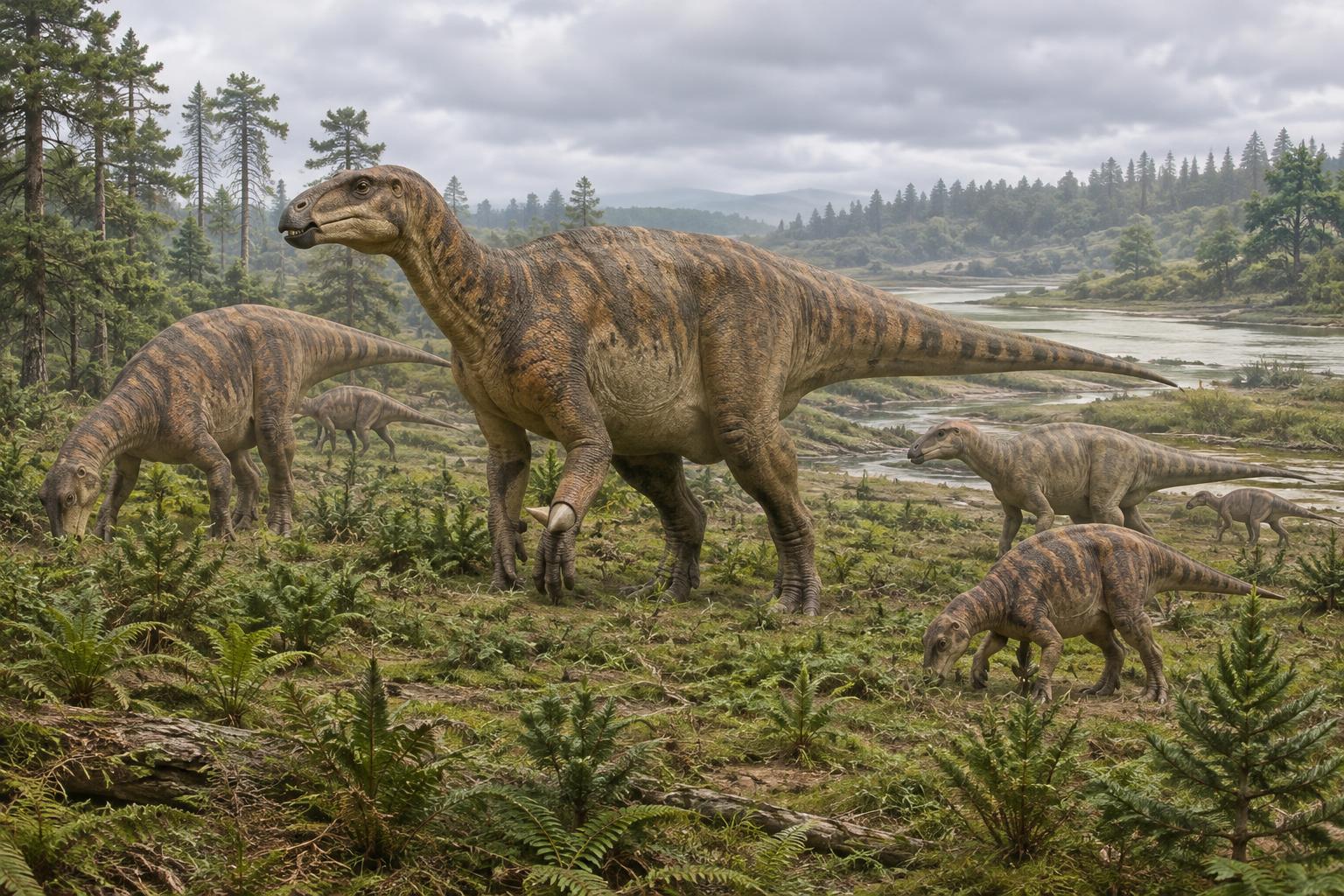
Iguanodon bernissartensis lived during the Early Cretaceous and is well known from fairly complete skeletons, notably those from Bernissart in Belgium. Fossils occur in deposits interpreted as riverine and floodplain environments, suggesting a preference for wet lowland plains and open woodlands. Anatomically, it was a large ornithopod with a robust body, long tail and flexible forelimbs capable of both grasping vegetation and supporting weight when the animal moved on all fours. It bore a characteristic large thumb spike on the first finger, which may have been used as a defensive weapon, a support, or in intraspecific interactions. A beak and battery of teeth indicate efficient cropping and processing of plant material compared with earlier ornithopods.
- Diet
- herbivore
- Size
- up to ~9–10 m length
- Weight
- about 3–5 tonnes (est.)
Behavior
Observation history
Young Iguanodons are sometimes seen gambolling near riverbanks while cautious adults stand in a loose formation, one rearing on its hind legs to scan the horizon. When alarmed, the herd can advance as a compact mass to shield smaller members, a spectacle often described by park watchers.
At sunset the animals cast long shadows over the floodplain, lending the scene an ancient, primeval atmosphere — a living window into deep time on the virtual island.
Facts
- I. bernissartensis is known from several well-preserved skeletons discovered in Bernissart, Belgium.
- The distinctive thumb spike is probably the most recognizable feature of the genus.
- Likely a facultative biped able to feed on all fours as well as on hind legs.
- Adapted for cropping and processing plant material with a beak and dental battery.
- Associated with riverine and floodplain habitats in Early Cretaceous Europe.