Ankylosaurus magniventris
Ankylosaurus magniventris
Late Cretaceous
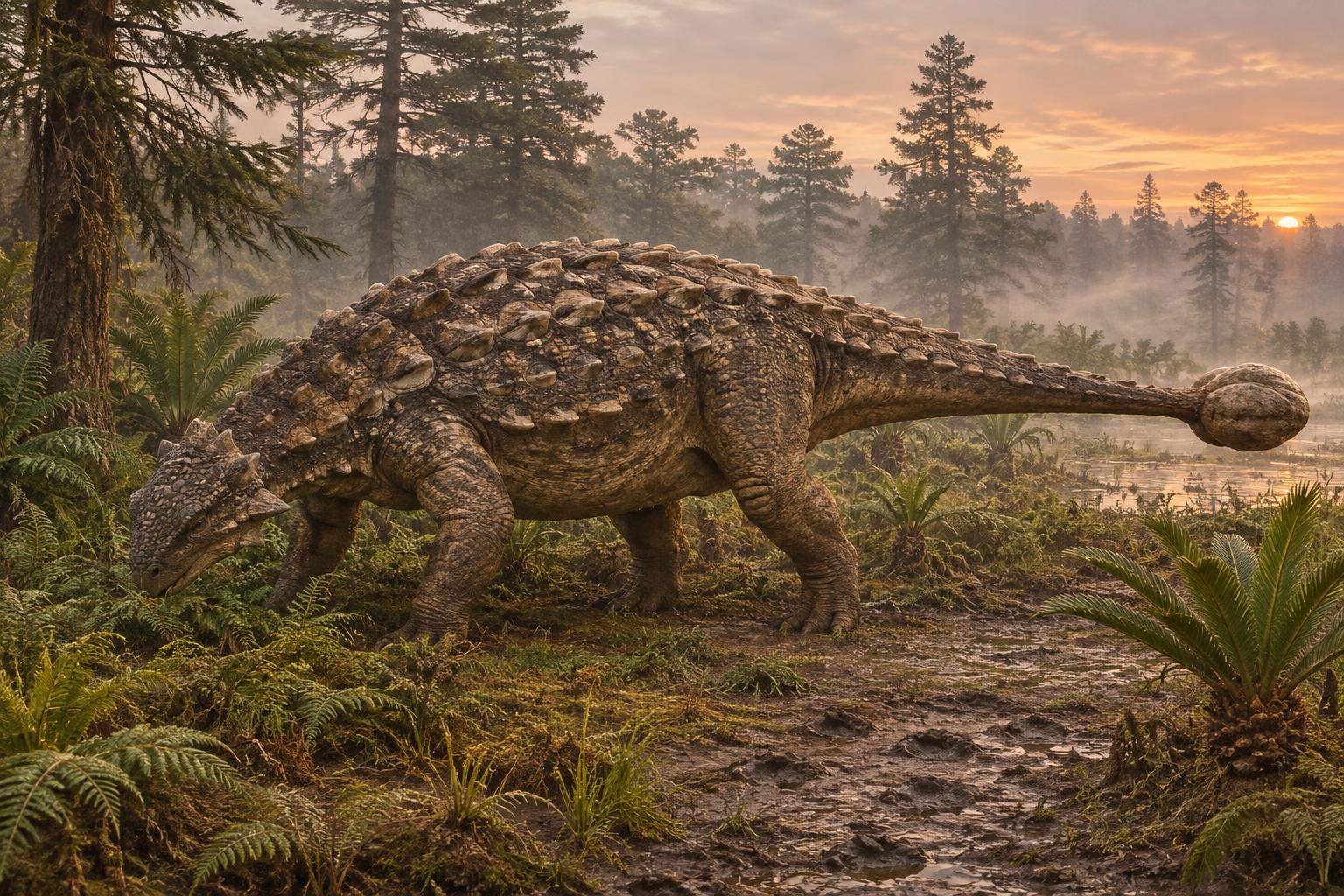
Ankylosaurus magniventris lived during the Late Cretaceous and is known from fossils found in North America. It is among the most highly specialized ankylosaurids: its body was covered with large bony plates (osteoderms) and knobs, and the thoracic and lateral regions were protected by dense armor. The holotype and referred material indicate a massive, low-slung animal with a broad, stout build and short, powerful limbs adapted to carry heavy armor.
- Diet
- herbivore
- Size
- 6–8 m length
- Weight
- ≈4–8 tonnes
Behavior
From paleontological evidence, Ankylosaurus is interpreted as a herbivore with a low head carriage and jaws suited for cropping and grinding tough vegetation. Much of its behavior is reconstructed: it was likely solitary or lived in small groups and relied on its armor and tail club for defense. Tail strikes could deliver powerful defensive blows, potentially injuring predators, but direct evidence for frequent combat is limited, so such scenarios remain partially hypothetical.
Observation history
On JuraLand the first sighting of Ankylosaurus occurred on a misty morning when a massive individual emerged from fern thickets and slowly crossed a ridge. Its armor shimmered with dew, and staff on observation platforms watched in awe as its heavy tail swayed ominously.
During a late-afternoon safari a young female Ankylosaurus reportedly blocked the path of a small predator, apparently defending her young; according to park lore she drove the threat off with a single powerful tail strike that left a deep impression in the soft ground.
Visitors commonly remark on the animals' deliberate pace: they feed on low vegetation and return to marshy clearings near the Valley of Giants, where they can often be seen at dusk in warm, diffuse light.
Facts
- Ankylosaurus is among the last and most specialized ankylosaurids.
- Possesses a massive tail club formed by fused vertebrae and ossified knobs.
- Armor included osteoderms of varying shapes set into the skin.
- The jaws and teeth were adapted for processing coarse plant material.
- Most knowledge comes from fragmentary bones and osteoderms, leaving some anatomical details uncertain.