18 November 2026
Young predators at the shore
 Scientific fact
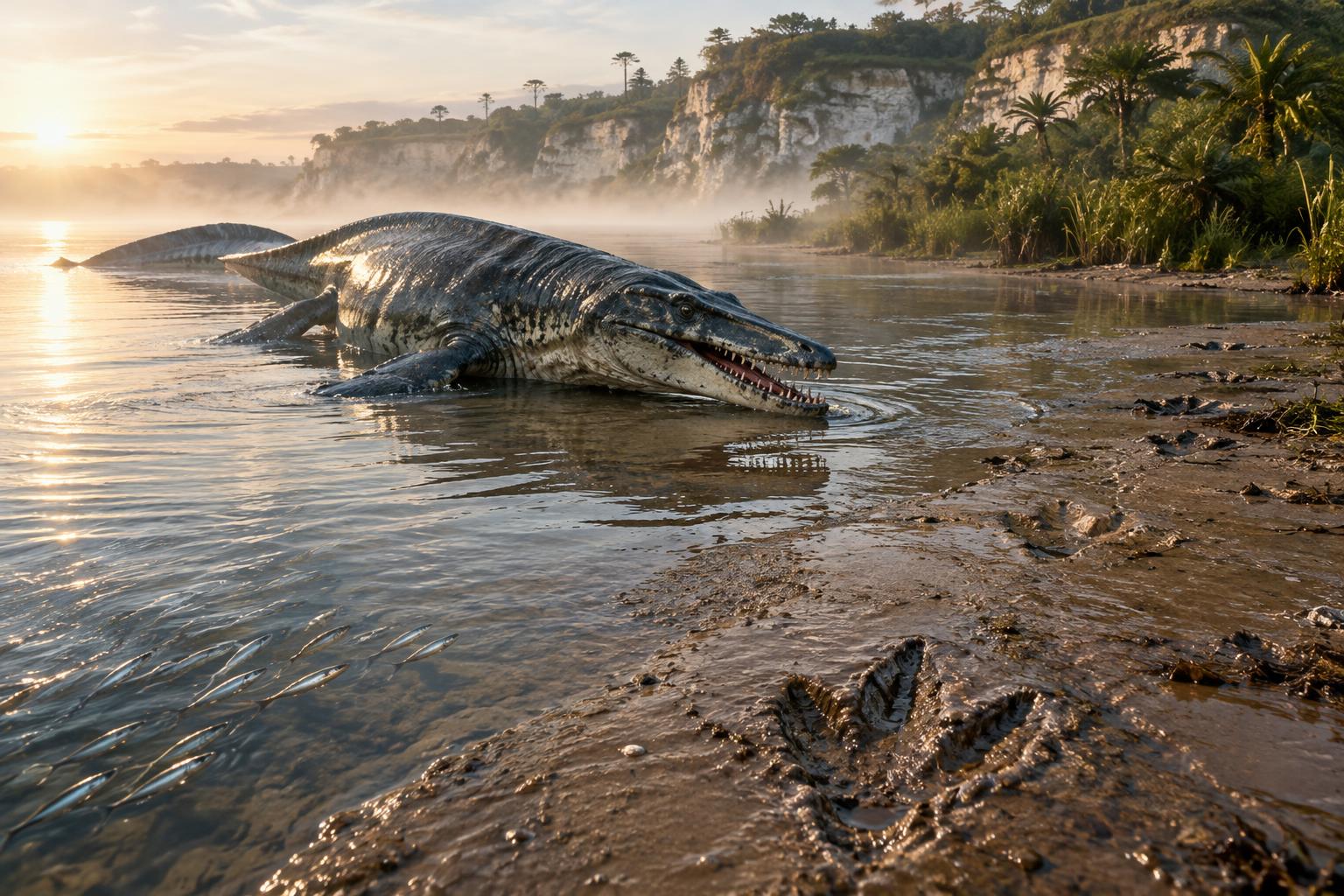
The recent sighting of a juvenile mosasaur along the shallows of Chalk Lagoon adds detail to how coastal predators share resources. These young marine hunters tend to remain in shallow flats, competing not so much with large open-water forms as with semi-aquatic dinosaurs like Baryonyx walkeri that specialize in fish and opportunistic scavenging.
The scientific fact supported by the sighting: coastal zones often exhibit clear spatial and trophic partitioning between juvenile marine predators and semi-aquatic hunters. Juvenile mosasaurs exploit shallow flats chasing smaller fish and cephalopods, while Baryonyx typically forages at the water's edge and wades into shallows to seize prey.
This partitioning reduces direct competition and allows coexistence of both groups, particularly when prey replenishment follows daily or seasonal cycles. For park management it is important to respect these behavioral boundaries when scheduling feedings and monitoring: interventions that create unnaturally high prey density at the shoreline can temporarily shift the balance.
Ongoing observations will refine the age window in which juvenile mosasaurs are most susceptible to competition and determine whether Baryonyx feeding peaks coincide with fish movements into the lagoon. For now, the recorded proximity appears as a natural mechanism limiting conflict among coastal predators.